Printable net generator
Nets of 3D Shapes: Free Printable Net Generator
A net is a flat pattern that folds into a 3D shape. This free generator draws an accurate net for a cube, rectangular prism, triangular prism, square, pentagonal or hexagonal pyramid and prism, tetrahedron, cylinder or cone at the size you choose, with dashed fold lines, optional glue tabs and the surface area of every face. Download a true-scale PDF for US Letter or A4, or a PNG/SVG for worksheets.
- Free, no sign-up
- 9 solids, any size
- True-scale PDF
- cm or inches
- Surface area shown
1. Choose a 3D shape
2. Options
3. Print at true size
Print at 100% (“Actual size”). The PDF has a check box of known width so you can confirm the scale.
PNG size & background
The PNG stores its print size, so Word and Google Docs insert it at about 16 cm wide. Every PNG and SVG also contains the project, so you can drop it back into the Geometry Editor to keep editing.
Surface area & properties
96 cm²
Total surface area (the tabs are not included)
| 6 × Face | 6 × 16 = 96 cm² |
|---|---|
| Volume | 64 cm³ |
| Faces / edges / vertices | 6 / 12 / 8 |
How to make a printable net
- 1
Choose a shape
Pick a cube, rectangular prism, triangular prism, pyramid, tetrahedron, regular prism, cylinder or cone.
- 2
Enter the size
Type the dimensions in centimetres or inches. The net and the surface area update as you type.
- 3
Set the options
Keep the grey glue tabs for building a model, or turn them off for a worksheet. Label faces with names, areas or edge dimensions.
- 4
Download the PDF
Choose US Letter or A4 and download. The PDF is drawn at true size, with a check box of known width.
- 5
Print at 100%
In the print dialog choose “Actual size” or 100%, not “Fit to page”. Card stock (160–200 gsm, about 65–110 lb) folds best.
- 6
Cut, score and fold
Cut along the solid lines, score and fold along the dashed lines, then glue each tab under the edge it meets.
What is a net of a 3D shape?
A net is a two-dimensional pattern of a solid’s faces, joined along edges, that folds up into the solid without gaps or overlaps. Cut out a cereal box along a few edges and lay it flat, and you have the net of a rectangular prism.
Faces, edges and vertices
Each polygon in the net is a face. Dashed lines inside the net become edges when you fold, and the corners where edges meet become vertices. For any polyhedron, faces − edges + vertices = 2 (Euler’s formula).
One solid, many nets
Most solids have more than one net. A cube has 11 different nets; this generator uses the most common layout for each shape so the tabs and fold order are easy to follow.
Faces, edges, vertices and surface-area formulas
| Solid | Faces | Edges | Vertices | Net is made of | Surface area |
|---|---|---|---|---|---|
| Cube (edge a) | 6 | 12 | 8 | 6 squares | 6a² |
| Rectangular prism (l × w × h) | 6 | 12 | 8 | 3 pairs of rectangles | 2(lw + lh + wh) |
| Triangular prism | 5 | 9 | 6 | 2 triangles + 3 rectangles | 2 × triangle area + perimeter × length |
| Square pyramid (base b, slant s) | 5 | 8 | 5 | 1 square + 4 triangles | b² + 2bs |
| Regular tetrahedron (edge a) | 4 | 6 | 4 | 4 equilateral triangles | √3 · a² |
| Hexagonal prism | 8 | 18 | 12 | 2 hexagons + 6 rectangles | 2 × hexagon area + 6 × edge × length |
| Cylinder (r, h) | 3 (2 flat, 1 curved) | 2 (curved) | 0 | 1 rectangle + 2 circles | 2πr² + 2πrh |
| Cone (r, slant l) | 2 (1 flat, 1 curved) | 1 (curved) | 1 (apex) | 1 circle + 1 sector | πr² + πrl |
The 11 nets of a cube
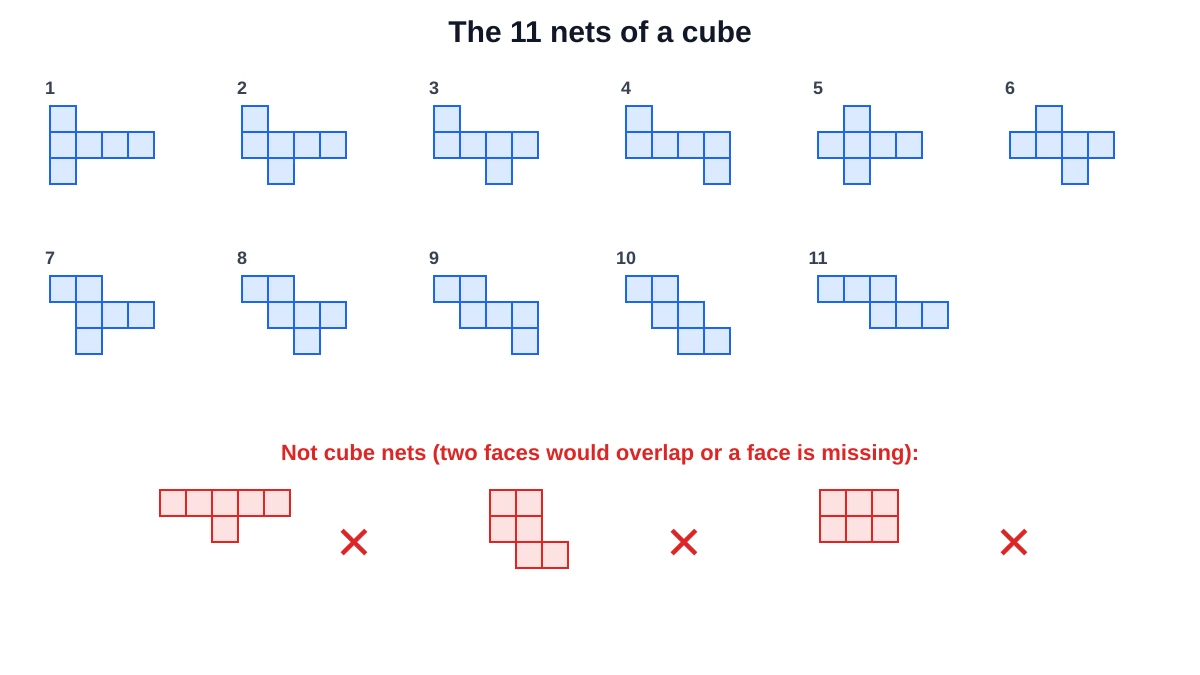
There are 35 ways to join six squares edge to edge (called hexominoes). Exactly 11 of them fold into a cube; rotations and reflections of a net are not counted as new nets. The other 24 overlap or leave a face open when folded.
How to tell if six squares fold into a cube
- A net never contains a 2 × 2 block of squares: two of those faces would overlap.
- A net never has five or more squares in a straight row.
- If you are unsure, imagine one square as the base and fold the others up around it, or cut it out and try.
The generator’s cube net is the classic “cross” layout: a row of four squares with one square above and one below the second square. Make a cube net at your own size.
Surface area using nets
A net shows every face at once, which makes surface area easy: find the area of each face, then add them up. Glue tabs are not part of the surface area. This is the method in Common Core standard 6.G.A.4, which asks students to “represent three-dimensional figures using nets made up of rectangles and triangles, and use the nets to find the surface area of these figures.”
| Solid | Dimensions | Working | Surface area |
|---|---|---|---|
| Cube | a = 4 cm | 6 × 4² | 96 cm² |
| Rectangular prism | 5 × 3 × 2 cm | 2(15 + 10 + 6) | 62 cm² |
| Triangular prism | Right triangle 3-4-5 cm, length 10 cm | 2 × 6 + (3 + 4 + 5) × 10 | 132 cm² |
| Square pyramid | Base 6 cm, height 4 cm (slant 5 cm) | 36 + 4 × ½ × 6 × 5 | 96 cm² |
| Cylinder | r = 3 cm, h = 10 cm | 2π × 3 × (3 + 10) | ≈ 245.04 cm² |
| Cone | r = 3 cm, height 4 cm (slant 5 cm) | π × 3 × (3 + 5) | ≈ 75.40 cm² |
| Regular tetrahedron | Edge 4 cm | √3 × 4² | ≈ 27.71 cm² |
Set Labels on faces to Face areas to print each face’s area inside it, or to Dimensions on edges so students work out the areas themselves.
Nets of curved solids: cylinder and cone
Cylinder
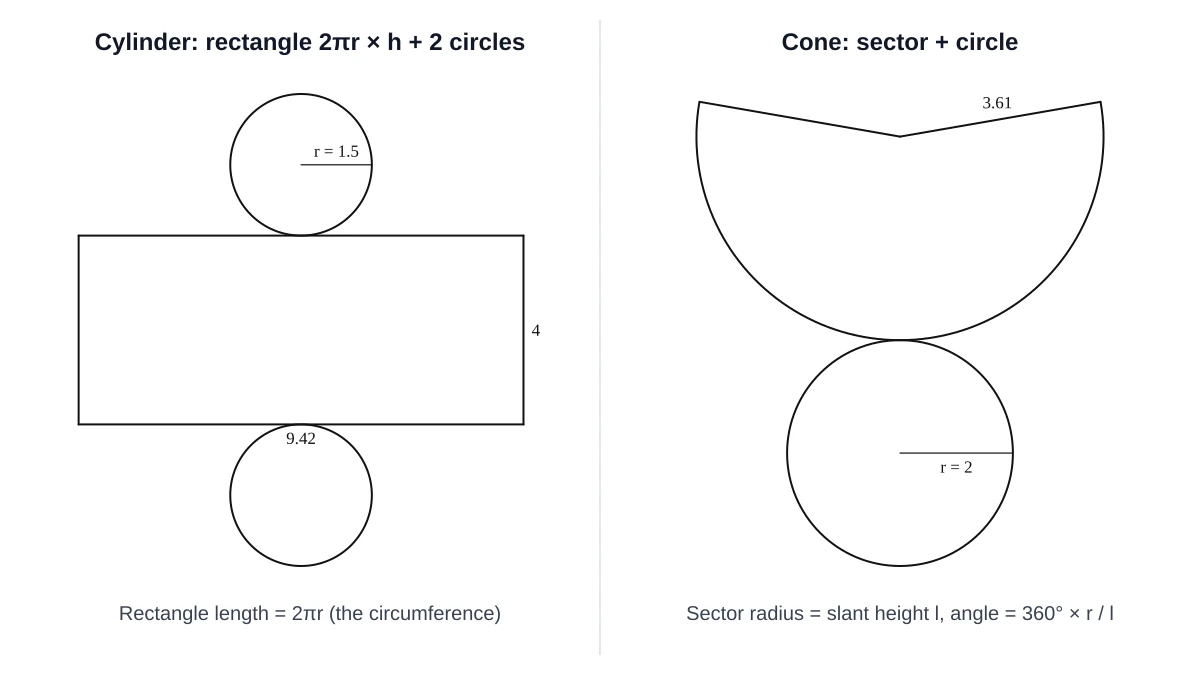
Unroll the curved side of a cylinder and you get a rectangle. Its height is the cylinder’s height and its length is the circumference of the base, 2πr. Add two circles of radius r for the top and bottom. A cylinder with r = 3 cm and h = 10 cm has a rectangle of about 18.85 × 10 cm.
Rectangle: 2πr × h, plus 2 circles of radius r
Cone
The curved surface of a cone unrolls into a sector of a circle. The sector’s radius is the slant height l = √(r² + h²), and its arc length equals the base circumference 2πr, so its angle is:
Sector angle = 360° × r / l
For r = 3 cm and height 4 cm, l = 5 cm and the sector angle is 360° × 3 / 5 = 216°. The generator calculates the slant height and sector angle for you and shows them under the net.
How to print a net at true size
- Pick US Letter or A4 before downloading, to match your paper.
- Open the PDF and choose Actual size or 100% in the print dialog. Turn off “Fit to page” or “Shrink oversized pages”.
- Measure the check box at the bottom of the page: it should be exactly 2 cm (or 1 inch) wide.
- Use card stock for models that need to stand up; ordinary paper is fine for worksheets.
If a net is too big for one page at the size you chose, the generator tells you the real size so you can make the shape smaller.
How to cut, score and fold a net
- Cut along the solid outline, including around the grey tabs.
- Score every dashed line with a ruler and an empty ballpoint pen or a blunt knife. Folds come out sharp and straight.
- Fold all the dashed lines in the same direction first, so the printed side ends up outside.
- Glue one tab at a time with a glue stick or a little PVA, tucking each tab inside the face it meets. Close the last face last.
- For cylinders and cones, glue the small teeth under the edge of each circle a few at a time.

Classroom and homeschool activities
- Build and measure: students build a prism, measure it, and check the surface area against the printed face areas.
- Cube-net sort: print several six-square patterns; students predict which fold into a cube, then test them.
- Predict, then check: print with Dimensions on edges and tabs off, ask for the surface area, then reveal the version with face areas.
- Packaging design: design a box with a given volume and the smallest surface area.
- Gift boxes and models: cubes and pyramids at 6–10 cm make neat boxes and decorations.
Curriculum links
| Curriculum | Where nets appear |
|---|---|
| US Common Core, grade 6 | 6.G.A.4: represent 3D figures using nets and use them to find surface area |
| England, Year 6 (KS2) | Recognise, describe and build simple 3D shapes, including making nets |
| England, KS3 | Use the properties of faces, surfaces, edges and vertices of cubes, cuboids, prisms, cylinders, pyramids, cones and spheres |
Nets of 3D shapes FAQ
A net is a flat, two-dimensional pattern that folds into a 3D solid without overlapping. It is made of the solid's faces joined along their edges.
A cube has 11 different nets. Of the 35 ways to join six squares edge to edge, exactly 11 fold into a cube; rotations and reflections are not counted separately.
Find the area of each face in the net and add them together. The glue tabs are not part of the surface area. The generator lists every face area and the total.
A rectangle and two circles. The rectangle's length is the circumference of the base (2πr) and its width is the height of the cylinder.
A circle for the base and a sector for the curved surface. The sector's radius is the slant height l and its angle is 360° × r / l.
Two triangles and three rectangles. Usually the three rectangles sit in a row, with a triangle attached to the top and bottom of one of them.
Download the PDF for your paper size (Letter or A4) and print at 100% or Actual size, not Fit to page. Then check the box at the bottom of the page: it should measure exactly 2 cm or 1 inch.
For building a model, yes: keep tabs on and each seam gets one tab. For worksheets and surface-area questions, turn tabs off.
Yes. The nets, PDFs and images you make here may be used in classroom materials and commercial products. No attribution is required.
Usually two squares would overlap or a face is missing. Six-square patterns with a 2 × 2 block or five squares in a row never fold into a cube. Compare with the 11 valid nets.
Last updated · GeometryKit is free to use for classroom and commercial worksheets.